How to Structure Your Home Loans When Building a Property Portfolio
Buying your first investment property and building a property portfolio are not quite the same thing. With one property, the question might simply be, “Can I get the loan approved?” With a growing portfolio, the questions become more strategic:
Which lender should hold which debt? How should equity be released? Should loans be principal and interest or interest only? Where should offsets sit? How will today's lending decision affect borrowing capacity for the next property?
This is why I believe investors should think beyond the next approval.
Property #2 should be structured with property #3 in mind.
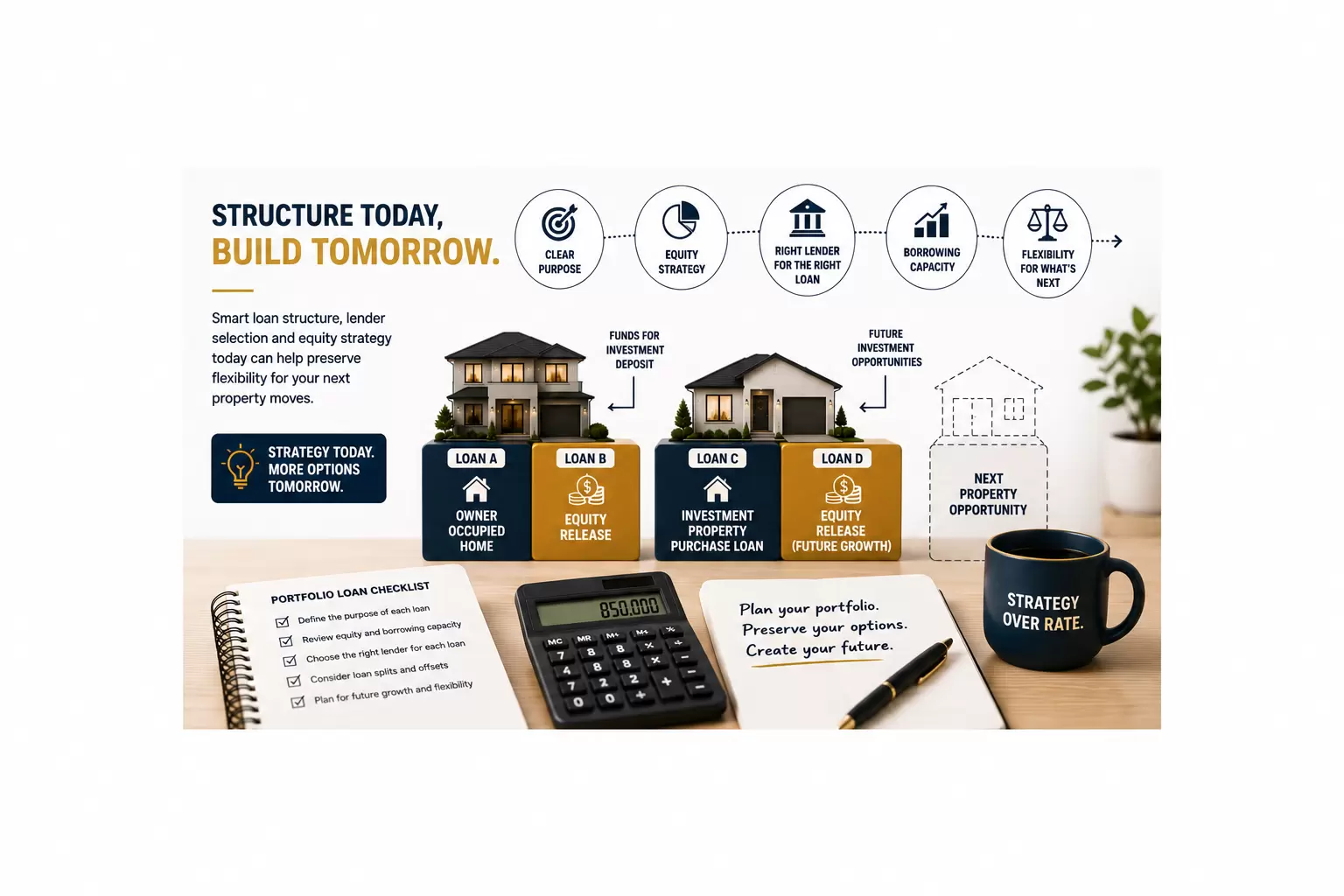
Every loan should have a purpose
One of the simplest principles I use when looking at investment lending is:
Every loan should have a job.
For example:
Loan A: Owner-occupied home debt
Loan B: Equity release used for an investment property deposit
Loan C: Investment property purchase loan
Loan D: Equity release for a later investment purchase
Different purposes may warrant separate facilities. This can make the lending easier to manage and easier for your accountant to trace, and can also avoid unnecessarily mixing personal and investment borrowing.
Be careful about cross-collateralising properties
One structure lenders sometimes use is securing multiple loans against multiple properties — known as cross-collateralisation. It can work, but property investors should understand the implications.
When multiple properties are tied together, refinancing or selling one property can potentially become more complicated because the lender may reassess the entire security position. In many circumstances, investors prefer standalone security structures where each property secures its own lending.
Whether this is appropriate depends on the situation. The important thing is that the structure should be deliberate — not simply whatever arrangement happens to be easiest at settlement.
Separate equity from the investment purchase loan
Suppose you own a home and want to use $150,000 of equity towards another investment. A possible structure could be:
Home Loan: Existing home debt
Equity Split: $150,000 for investment-related deposit and costs
Investment Loan: Remaining lending secured against the new investment property
This creates a clearer distinction between the original home debt and the additional borrowing used for investment purposes. Again, the tax treatment depends on how borrowed money is actually used — speak with a qualified tax professional before relying on any expected deduction.
Don't automatically put every property with the same bank
Staying with one bank can feel easier — one internet banking login, one relationship, one set of statements. But from a portfolio lending perspective, having every property with the same lender isn't always optimal.
Lender policies differ, and as your portfolio grows, a lender that was excellent for property #1 may not be the lender that best supports property #3. Sometimes diversifying lenders can provide greater strategic flexibility; other times keeping lending together makes more sense. There is no universal rule — the key is making lender selection part of the strategy rather than defaulting to convenience.
Interest rate is important — but so is servicing
Imagine Bank A offers an investment rate 0.10% lower than Bank B. At first glance, Bank A wins. But what if Bank B's servicing policy allows you to complete your next planned investment purchase while Bank A doesn't? Suddenly that 0.10% difference needs to be considered in a wider context.
This does not mean ignoring interest rates. It means comparing rate, loan features, repayments, lender policy, borrowing capacity, flexibility and future objectives together. A mortgage strategy is rarely about optimising one number.
Principal and interest vs interest only
This is another important portfolio question. Principal-and-interest repayments reduce debt over time. Interest-only repayments may provide lower required repayments during the interest-only period but don't reduce principal unless additional repayments are made.
For some investors, interest only may support short-term cash flow. For others, paying down debt is the priority. Interest-only rates can also be higher, and repayments generally rise when the interest-only period ends. There is no automatically correct option — the repayment type should match your goals, cash flow and risk tolerance.
Offset accounts can be valuable — but structure matters
Offset accounts can help borrowers reduce interest while keeping funds accessible. But when an investor has owner-occupied and investment debt, the location of cash can become important. If tax deductibility is relevant, speak with your accountant about how offsets, redraws and loan purposes interact before frequently moving funds around.
Getting the structure right at the beginning can be far easier than trying to untangle mixed borrowing later.
Think two moves ahead
Suppose you can borrow enough to purchase another investment today. Great. But I would also want to know: what happens after settlement? How much borrowing capacity remains? How much cash buffer remains? What will the new repayments look like? Will you still have usable equity elsewhere? Which lender options remain open? What needs to happen before the next purchase becomes possible?
That's the difference between arranging a mortgage and thinking about portfolio finance.
A portfolio strategy shouldn't mean maximising debt
The objective isn't “How much debt can we possibly get approved?” — more borrowing creates more repayments and more financial risk. The objective should be: how do we structure appropriate lending to support your goals without unnecessarily limiting your future options?
Sometimes that means buying. Sometimes that means refinancing. Sometimes it means paying down debt. And sometimes the best lending decision is to do nothing for a while. Strategy includes knowing when not to borrow.
Your next loan affects the one after it
As a portfolio grows, each financial decision becomes connected — today's lender, today's loan term, today's equity release, today's repayment structure. All of these can influence tomorrow's options.
That's why investors may benefit from reviewing their entire lending position rather than treating every property purchase as an isolated transaction. At Fundex Capital, our aim is to understand where you want to go, then structure the lending around that bigger picture.
Not just the next loan. The next few moves.
Quick questions
What does it mean for “a loan to have a job”?
It means each loan is set up for one clear purpose — such as owner-occupied debt, an equity release, or a specific property purchase — rather than mixing purposes together in one facility. This keeps lending easier to track and simpler for tax purposes.
Should I keep all my investment properties with the same bank?
Not necessarily. A lender that suited your first purchase may not offer the best policy or servicing outcome for your third. Lender selection is often part of the overall portfolio strategy rather than a one-off decision.
Is cross-collateralising properties a bad idea?
It isn't automatically bad, but it can make refinancing or selling one property more complex, since the lender may reassess your entire security position. Many investors prefer standalone structures for that reason, though it depends on your situation.
Related reading
→ Should You Refinance Before Buying an Investment Property? — /refinance-before-buying-investment-property/
→ Why Your Borrowing Capacity Can Change — Even When Your Income Hasn't — /investment-property-borrowing-capacity/
Ready to review your property portfolio finance strategy? We can assess your current mortgages, usable equity, borrowing capacity and lender options, then map out what a sensible next step could look like.