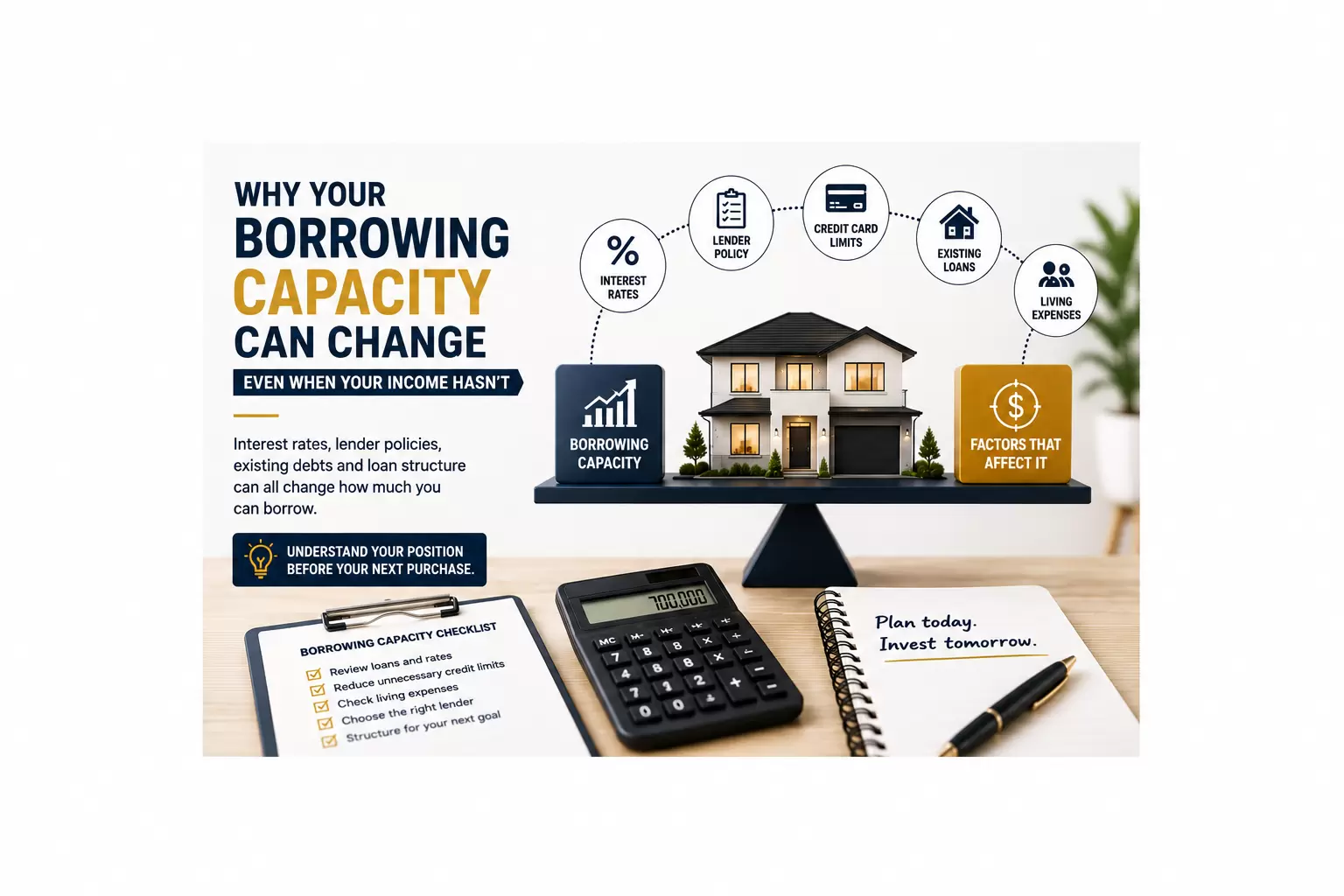
Why Your Borrowing Capacity Can Change — Even When Your Income Hasn't
One of the biggest misconceptions in property finance is:
“I could borrow $700,000 last year, so I should still be able to borrow $700,000 now.”
Unfortunately, borrowing capacity doesn't work like that. You can have the same job, the same salary, the same house — and still receive a very different borrowing result six months later. Why? Because your income is only one part of a lender's calculation.
Borrowing capacity is a moving number
A lender needs to determine whether you can afford the proposed loan — not simply today, but under its own assessment assumptions. That calculation can change because of:
● interest rates
● assessment rates
● lender policy
● your living expenses
● credit card limits
● personal loans
● dependants
● rental income
● existing mortgage repayments
● your income type
● your loan term
● other properties you own
Change one or two variables and the outcome can move substantially.
Different lenders can produce different answers
This is particularly important for investors. One lender may assess rental income differently from another. Another may treat an existing investment loan differently. One may be more suitable for bonus income; another may work better for someone who is self-employed. And lender policy changes over time.
This is why asking “How much can I borrow?” isn't always enough. The better question can be:
“How much could I borrow with the lenders that suit my circumstances?”
Credit cards can have a bigger impact than expected
A common surprise is unused credit card limits. You may have a $20,000 credit card with a zero balance and think, “I don't owe anything, so it shouldn't matter.” But many lenders assess the available limit, not simply the current balance, when calculating your commitments.
That unused facility can therefore reduce borrowing capacity. For someone trying to maximise their investment purchasing position, reviewing unnecessary credit limits can sometimes make a meaningful difference — that doesn't mean cancelling every card automatically, but it does mean understanding how they're being assessed.
Your existing loan term can matter too
Imagine you have $700,000 remaining on an existing mortgage. If only 18 years remain, the contractual repayment can be significantly higher than it would be over 30 years. Depending on the lender and application structure, that can affect servicing.
This is why reviewing an investor's existing lending can be just as important as comparing rates on the new loan. Sometimes the obstacle isn't the next mortgage — it's the structure of the debt you already have.
Rental income doesn't necessarily count dollar for dollar
Investors commonly ask, “The property rents for $700 per week — doesn't the bank count all of that?” Usually, lenders apply their own assessment methodology. They may shade the rental income to allow for expenses, vacancies and other risks, and the exact treatment varies between lenders. This can influence how much additional investment debt they'll allow you to take on. Again, lender selection matters.
Your property equity and borrowing capacity are connected — but different
You could have $500,000 in property equity and still be unable to access much of it. Why? Because the lender still needs to be satisfied you can service the additional loan. Think of it this way:
Equity tells us what security may be available. Borrowing capacity tells us how much debt the lender may allow.
For an equity-release strategy to work, we generally need both.
Why investors should check borrowing capacity early
Suppose you're thinking about purchasing an investment property sometime within the next year. You might assume there's no reason to speak to a broker until you've found one. But checking your borrowing position earlier can reveal things we have time to work on, for example:
● reducing unnecessary credit limits
● reviewing expensive personal debt
● refinancing existing lending
● changing lenders where appropriate
● restructuring loan terms
● gathering appropriate income evidence
● understanding how much cash or equity will be required
These aren't things you necessarily want to discover three days after signing a contract. The earlier we know the problem, the more options we may have to address it.
Can you improve borrowing capacity?
Potentially. But it shouldn't become an exercise in manipulating numbers simply to borrow the maximum possible amount. The aim should be to establish a sensible lending position that supports your goals and remains manageable. Depending on your circumstances, potential areas to review may include:
1. Existing interest rates and repayments
2. Loan terms
3. Credit card limits
4. Personal loans or car finance
5. Lender selection
6. Income evidence
7. Existing property debt
8. Proposed repayment structure
Some changes can help. Others may have trade-offs. That's why the overall strategy matters.
Don't wait until you need the approval
Your borrowing capacity isn't something you should assume will simply be there whenever you're ready. Your circumstances can change. Lenders can change. The market can change. Policies can change.
You can't control every variable. But you can understand your position before you need to rely on it.
Quick questions
Why did my borrowing capacity drop even though my income is the same?
Borrowing capacity depends on more than income — interest rates, assessment rates, lender policy, living expenses and existing debts all factor in, and any one of these can shift the outcome even if your income hasn't changed.
Do unused credit cards really affect how much I can borrow?
Yes. Many lenders assess your full available credit limit, not your current balance, when calculating your commitments — so an unused $20,000 limit can still reduce what you're able to borrow.
How early should I check my borrowing capacity before buying again?
Ideally 6–12 months out. That gives time to address anything working against you — like unnecessary credit limits, loan structure or lender fit — before you're under contract deadlines.
Related reading
→ How Much Equity Can You Actually Access From Your Property? — /usable-equity-investment-property/
→ Should You Get Your Finance Ready Before the Property Market Moves? — /prepare-finance-before-investment-property/
If another property is part of your plans over the next 6–12 months, consider reviewing your borrowing capacity now. At Fundex Capital, we'll assess your current lending position, compare suitable lender servicing outcomes and help you understand what your realistic next step could look like.